Optimizing Feature Extraction for Symbolic Music
Federico Simonetta, Ana Llorens, Martín Serrano, Eduardo García-Portugués, Álvaro Torrente
Published in ISMIR 2023
A readable take
Written with GPT-5.4
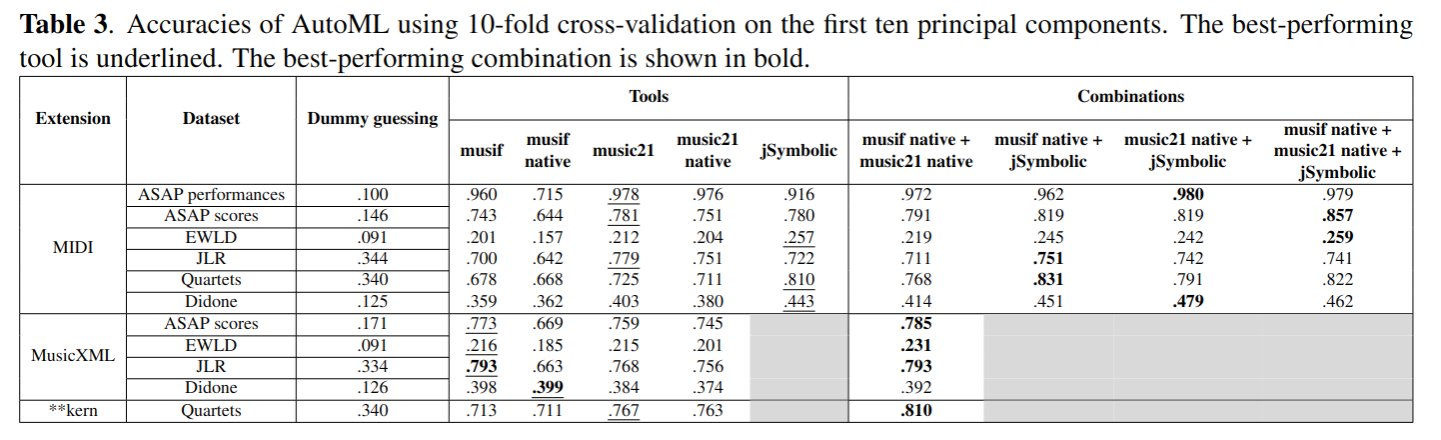
This paper asks a plain but important question: if you want to describe musical style from digital scores, which extractor is actually worth using? Rather than defending a favorite tool, it compares jSymbolic, music21, and the new package musif across several corpora and formats, including MIDI, MusicXML, and **kern.
The sharpest point is the comparison between MIDI and richer score encodings. One might expect MusicXML to win by default because it can preserve more notation. The paper shows a less tidy reality. In several tasks, MIDI remains surprisingly competitive; in some cases it even does better. The reason is concrete, not philosophical: a richer file is only useful if the extractor can convert that extra notation into robust features for the classification task.
This is where harmony becomes the real hook. musif can use harmonic annotations and, on the Didone opera dataset, those features produce a clear improvement. That result matters because it shows what “more information” actually means in practice. Not every extra symbol in a file helps, but explicit harmonic structure can. So the paper is not just a software benchmark: it shows which musical knowledge is worth encoding.
The broader lesson is equally practical. No single toolbox dominates everywhere. The best results often come from combining feature sets, but the most revealing gains appear when the added features capture something musically substantive rather than merely increasing quantity. Here, harmony is the detail that earns its keep.