Multimodal Domain Generalization for Depression Detection: An Attention-Based BiLSTM Network with Domain-Adversarial Training
Ali Tabaraei, Federico Simonetta, Stavros Ntalampiras
Published in IEEE Transactions on Neural Networks and Learning Systems 2026
A readable take
Written with Deepseek v4 flash
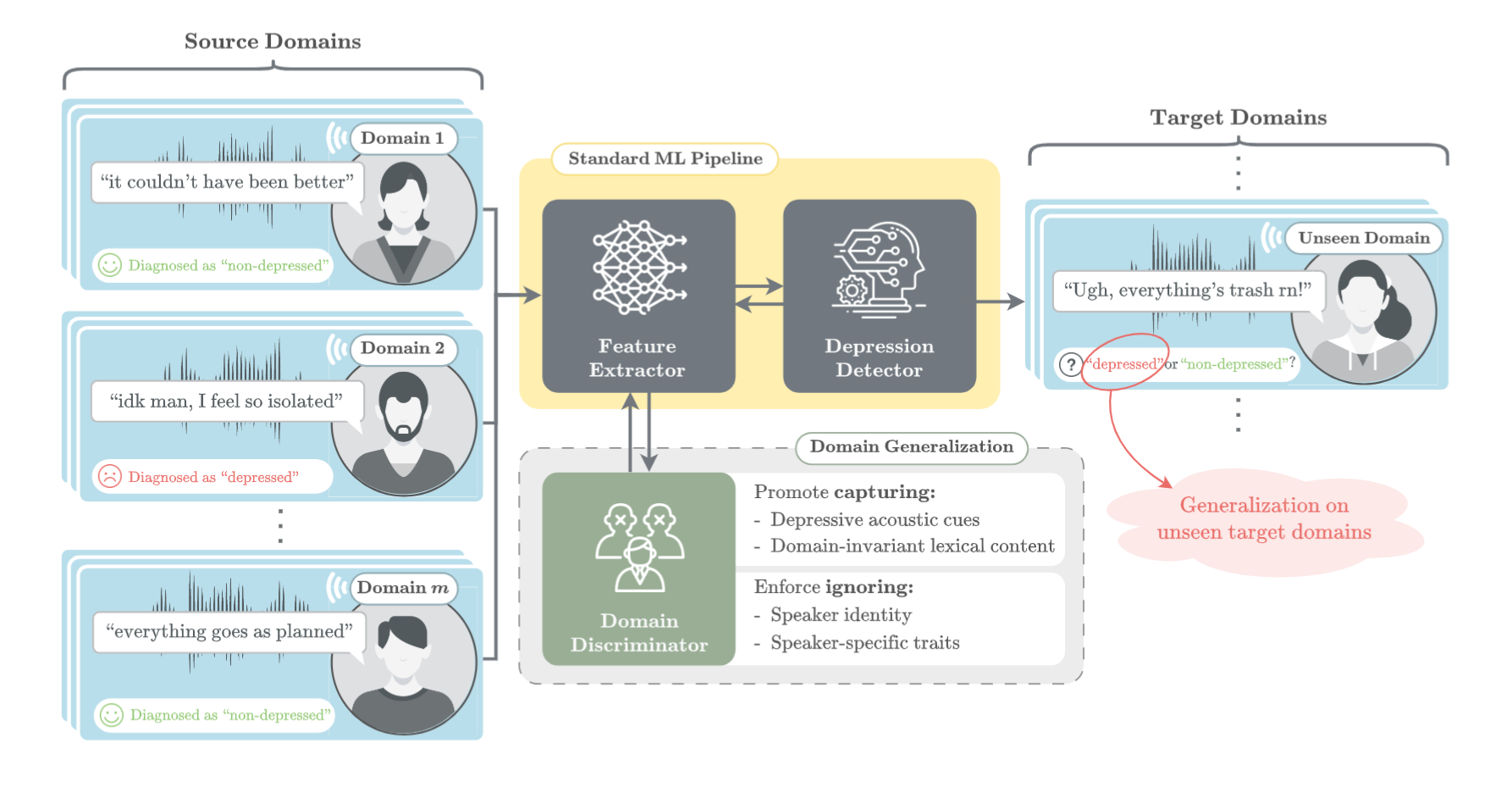
Most depression detection models overfit to individual speakers rather than depressive traits, so performance drops on unseen patients. This paper builds the first multimodal (audio + text) framework that tackles that gap.
The architecture pairs MelSpec spectrograms with ItalianBERT text embeddings through a BiLSTM with intra- and cross-modal attention. The key addition is a gradient reversal layer (GRL) that forces the feature extractor to produce speaker-invariant representations. The domain discriminator tries to guess the speaker, but the GRL inverts its gradients, making this adversarial training a tug-of-war the speaker loses.
On the Androids-Corpus dataset (Italian), the baseline hits 90.4% accuracy and 90.8% F1. Adding DG raises both to 93.2% and 94.2% - a 2.5% and 3.3% gain. The model surpasses all prior benchmarks despite using 20% less training data, with a 4.7% false negative rate that matters for clinical screening.